Sourcing & Buying Guides
Private Label Cat Scratchers: Complete Guide for Pet Brands
Private label cat scratchers let pet brands sell a proven product under their own name. MOQs, costs, timelines, artwork and quality checks — the full guide.
Private label means selling a proven cat scratcher under your own brand name. The factory makes it, you own the branding, the packaging and the customer relationship. This guide covers what you can customize, what it costs, how long it takes, and the quality checks to run before you approve production.
What Does Private Label Actually Mean?
Private label, OEM and ODM are three different ways to get a cat scratcher with your name on it, and buyers mix them up constantly:
- Private label: you take a proven, existing product and put your brand on it — your logo, your artwork, your packaging. The structure already exists and already works.
- OEM: you bring your own design, dimensions and specifications, and the factory builds exactly that.
- ODM: you pick a design from the factory's catalogue and the factory makes it with your branding.
In practice, most pet brands start with private label: the product risk is already removed, and the work goes into the brand instead of the engineering. If you want the full comparison, read OEM vs. ODM for Cat Scratchers: Which is Right for Your Brand?.
Why Do Pet Brands Choose Private Label?
Four reasons come up in almost every enquiry:
- Speed. There is no new shape to develop. Sampling and production follow the factory's standard timeline instead of a development cycle.
- Lower risk. The structure has already been produced, shipped and sold. You are not betting on an unproven design.
- Brand equity. The customer remembers your name, not the factory's. Every reorder strengthens your brand instead of a generic product.
- No tooling bill for a new shape. A new shape needs new cutting dies and trials. Private label skips that cost entirely, which matters most on a first order.
Private label is the right choice when your advantage is branding, distribution or retail placement — not a shape nobody has made before.
What Can You Customize on a Cat Scratcher?
More than most buyers expect. On our floor, a private label programme can change any of these, and they can be combined:
- Logo application. Your brand mark applied to the product surface, colour-matched to your artwork reference.
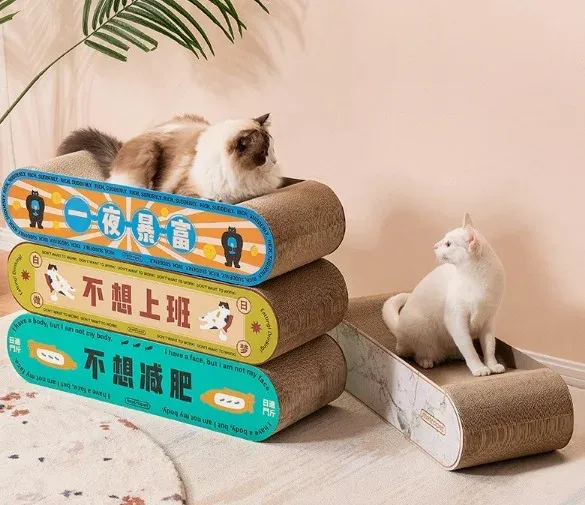
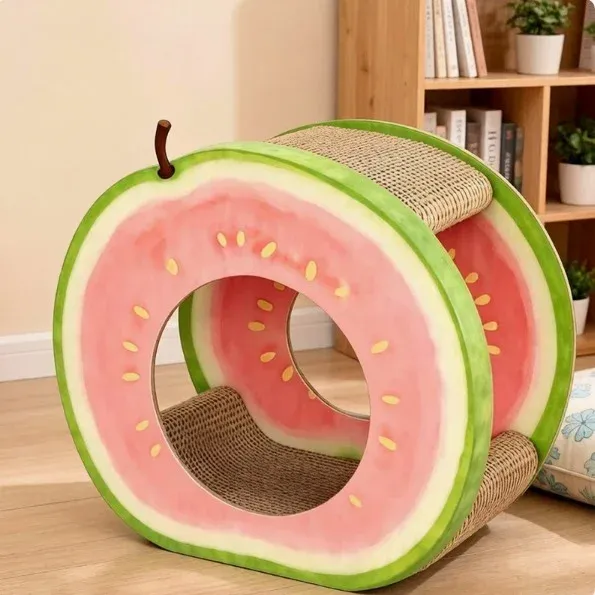
- Printed graphics. Patterns and seasonal artwork printed in-house on the board, rather than applied after production. Our custom printed white kraft range is built for exactly this.
- Custom packaging. Retail cartons, hang tags, inner packing and e-commerce-ready formats — the part of the product your customer actually sees first.
- Size and format changes. Dimensional changes to an existing style, or a new shape developed from your drawing if you want to go further than labelling.
- Material switching. Corrugated board, natural sisal rope or fabric wrap, matched to the end use and the price point. Corrugated suits high-turnover price points; sisal suits customers who report cardboard shedding.
- Colour and finish. Board colour, wrap colour and finish options, agreed against a physical sample before the run.
Tell the factory which of these matter to you in the first email. It changes the quote, the sampling plan and the timeline — all three are easier to get right when the brief is complete.
What Are the MOQs and Costs?
The numbers buyers plan around:
- Private label / OEM programmes start at 500 pcs. That is the minimum for a custom, branded run.
- Stock designs start lower, at 100–200 pcs. If you want to test a market before committing to a branded run, this is the cheaper way in.
- Sampling is quoted case by case, with the sampling cost, MOQ and lead time stated in the quotation before you commit.
What moves the unit price up or down: board grade (GSM and flute), product size, print coverage, packaging complexity and order quantity. A small printed flat board and a large furniture-style unit with a retail carton are not in the same price band, and no honest supplier quotes them as if they were. If a quote looks far below the rest, ask what was left out — board grade, print, packaging and inspection are the usual places. For the full picture on quantities, see What Is the Average MOQ for Wholesale Cat Scratchers?.
How Long Does a Private Label Order Take?
Plan on 27–40 days from brief to finished production, before freight:
- Sampling: 7–15 days. A physical sample is made to your specification. Production only starts after you approve it in writing, and artwork and colour are locked at that point.
- Production: 20–25 days after sample approval, depending on quantity and finishing. A pre-shipment inspection runs before packing.
Count backwards from your launch date, then add freight and customs on top. A range planned for a spring launch should be briefed in time for sampling to finish well before the season starts — the most expensive mistake in this business is a perfect product that arrives a month late. We worked through the arithmetic in Why Your Supplier's Lead Time is the Real Cost Killer in Q4, and the same logic applies to any season.
What Quality Checks Should You Run Before Approving?
Approve the sample like a buyer, not like a fan. Four checks catch most problems:
- Board grade. Ask for the board specification in writing. Our corrugated runs use 110–120 GSM BC flute; anything much lighter sheds faster and feels cheaper in the hand.
- The shedding test. Rub the scratching surface firmly for 30 seconds, then brush the debris off and look at what came loose. A good board sheds a little dust and keeps its structure; a bad one leaves crumbs and a visible bald patch. The full method is in Why Does Cardboard Cat Scratcher Shed? (And How to Test Quality).
- Print and edges. Check the print is sharp and the colours match your artwork reference, and run a finger along the cut edges — they should be clean, not frayed or crushed.
- Packaging. Open and close the retail carton the way a shopper would. If the box crushes, the hang tag tears or the inner packing shifts, fix it now, not after 500 units are packed.
Third-party inspection is welcome at our factory, and a factory visit before a first order is the fastest way to settle any doubt. For the full list of what to look for in the board itself, see How to Spot High-Quality Corrugated Board.
What Artwork and Packaging Files Does the Factory Need?
Send these with your brief and the quotation comes back faster:
- Your artwork in a print-ready format, with the logo as a vector file where possible, plus any colour references you want matched.
- Your packaging requirements: retail carton or e-commerce mailer, hang tags, inner packing, and any retailer labelling or barcode rules your market requires.
- Your target quantity and destination market. Both change the quote — quantity changes the unit price, and the destination changes the packing and the paperwork.
If you only have a photo of a product you like, that is enough to start. The factory works from reference samples, drawings or artwork, and flags anything outside its capability at the quotation stage rather than after the order.
How Do You Start a Private Label Programme?
- Brief. Send your reference sample, drawing or artwork, target quantity, destination market and any packaging requirement.
- Quotation. We return a unit price, MOQ, sampling cost, lead time and incoterms.
- Sampling. 7–15 days. A physical sample is made to your specification and approved by you before production.
- Production. 20–25 days, with in-process checks and a pre-shipment inspection before packing. Shipping documents follow your nominated forwarder or ours.
FAQ
What is the minimum order for private label cat scratchers?
500 pcs for a custom, branded programme. Stock designs without custom branding start at 100–200 pcs.
How long until my branded scratchers are ready to ship?
27–40 days from brief to finished production — 7–15 days for sampling, then 20–25 days for production after you approve the sample — plus freight time.
Can I use my own artwork and logo?
Yes. Your logo is applied to the product surface and your artwork is printed in-house on the board. Colour is matched to your reference and locked against the approved physical sample.
Do I need my own design, or can I pick from your catalogue?
Either. Private label starts from a proven design in the catalogue; if you want your own shape, that becomes an OEM programme built from your drawing, with the same sampling and approval process.
Can you handle retail packaging and barcodes?
Yes — retail cartons, hang tags, inner packing and e-commerce-ready formats are part of the programme. Send your retailer's labelling or barcode rules with the brief so they are built into the quotation.
Can I order a sample before committing to 500 pcs?
Yes. Sampling runs 7–15 days and every production run starts from an approved physical sample, so you see and approve exactly what will be produced.
Conclusion
Private label is the fastest honest route to a cat scratcher range with your name on it: a proven product, your branding, your packaging, and a fixed timeline you can plan around. The work that matters is upstream — a complete brief, a sample you approve in writing, and quality checks before production, not after.
Ready to start? Send your target styles, quantities and destination market through our contact page and we will reply with pricing, MOQ and sampling options, usually within one business day.